Is the battle of tree gender discrimination just a hoax?
Here is the subhead or additional content you want to add in
After a series of articles and tweets about cities being populated with only male trees (and remarks that this is just a conspiracy) I decided to see what the data has to say.
Earlier this week, tree-loving and city-dwelling-Twitter was rocked by a tweet from crop scientist Dr. Sarah Taber. Tree sexism was a lie!
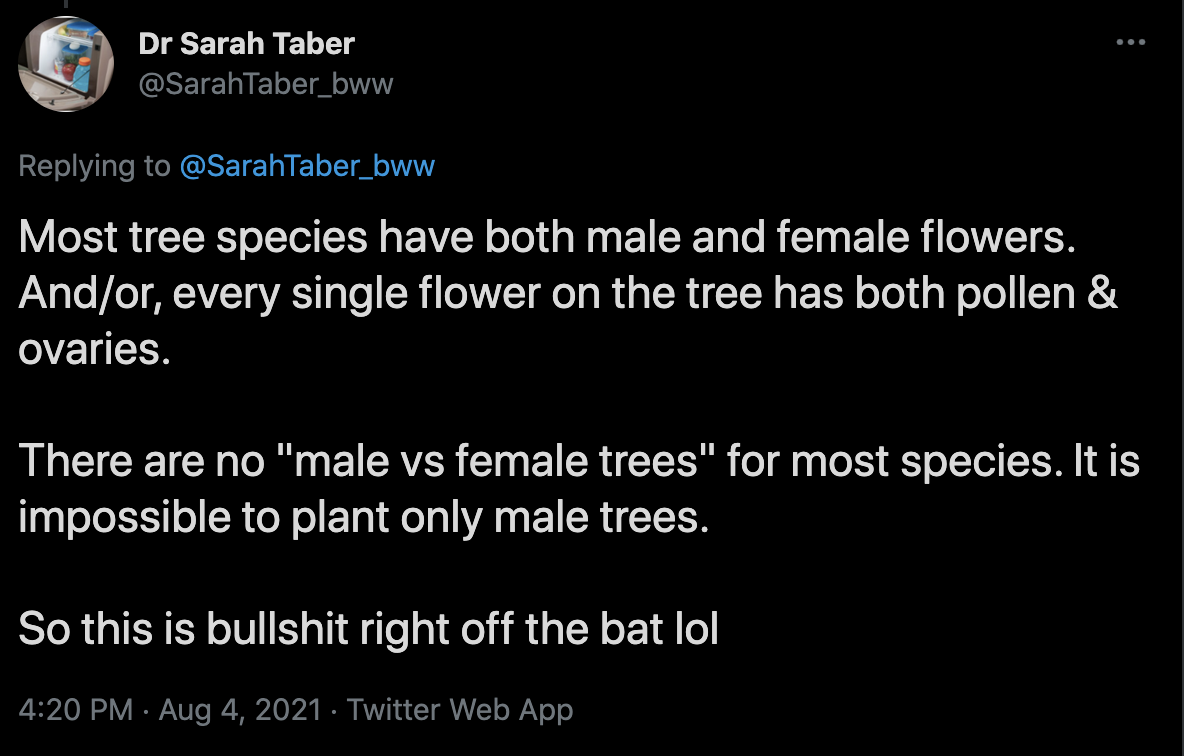
For years – or at least two years, based on a story from Atlas Obscura from 2019 – the idea has been spreading that high pollen counts in cities are due to cities only planting male trees. Cities supposedly do this to avoid having to deal with rotting fruit on the ground, which might be a bit worse than having a fit of sneezing every now and again.
Dr. Taber’s tweet storm threw this idea right out the window, pointing out that almost no trees have separate male and female trees. One of the sole exceptions is the ginkgo tree, which balances its hardiness with its awful smelly nature. But with ginkgo trees only being around 3% of the city’s trees (and 9% in Manhattan), can male trees really be to blame for the pollen situation?
First we’ll need to track down what trees besides the ginkgo have separate male and female trees. Following up on some notes from the University of Georgia, it turns out that the “sexual reproduction method” of trees can be broken down into a few different categories: cosexual, monoecious, dioecious and polygamous.
Out of these four groups, only dioecious trees have separate male and female trees. The others either have both male and female flowers or cycle back and forth between expressing each type. Even if barely any trees are dioecious, there’s always the possibility that NYC went out of its way to find only these rare dioecious trees to line our trees!
Luckily for us, every ten years NYC performs a street tree census, where volunteers count each and every tree on the city’s streets. Once it’s analyzed, the data itself can be found on the NYC Open Data portal. By combining this data with another University of Georgia dataset marking the sexual reproduction method of different types of trees, We’re able to see approximately how many dioecious trees are in NYC!
Out of the most common 20 trees on New York City’s streets, only three are dioecious! All together, they compose no more than 10% of the trees in the city.