A relational database printed to PDF, with redactions
This PDF is a set of complaint records from a local law enforcement agency — a database report printed to paper. Each complaint is a form-like block holding one-to-many tables of complaints and officers, the layout repeats with fields that are sometimes empty, and black redaction boxes break the automatic column detection right where you need it most.
This host rejects downloads from Python’s built-in urllib (a plain PDF(url) gets a 403), so fetch the bytes with requests and hand them to PDF() — it accepts any file-like object:
from io import BytesIO
import requestsfrom natural_pdf import PDF
url = "https://pub-4e99d31d19cb404d8d4f5f7efa51ef6e.r2.dev/pdfs/k046682-111320-opa-lea-database-install_1/k046682-111320-opa-lea-database-install_1.pdf"pdf = PDF(BytesIO(requests.get(url).content))pdf.show(cols=3)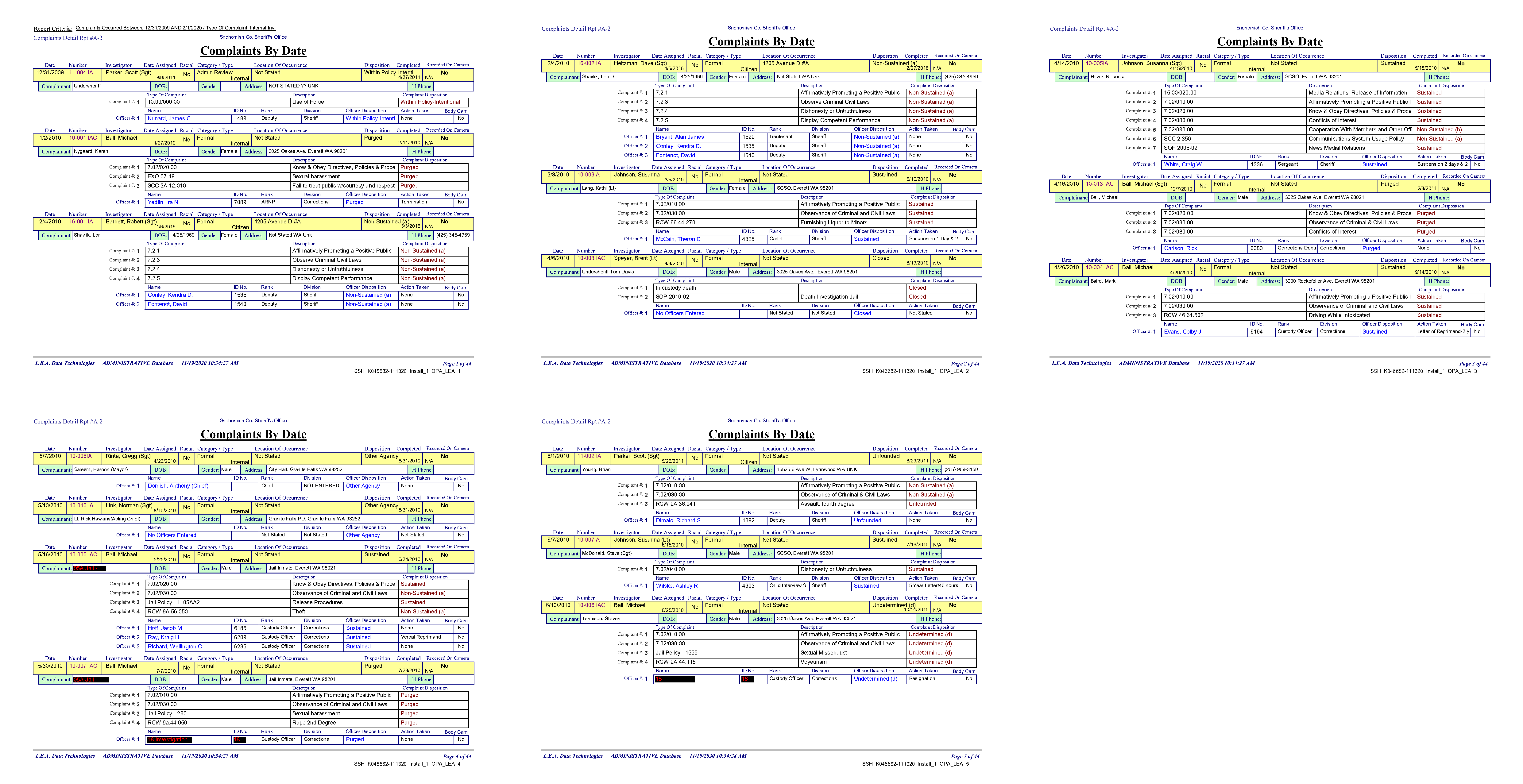
page = pdf.pages[0]page.show()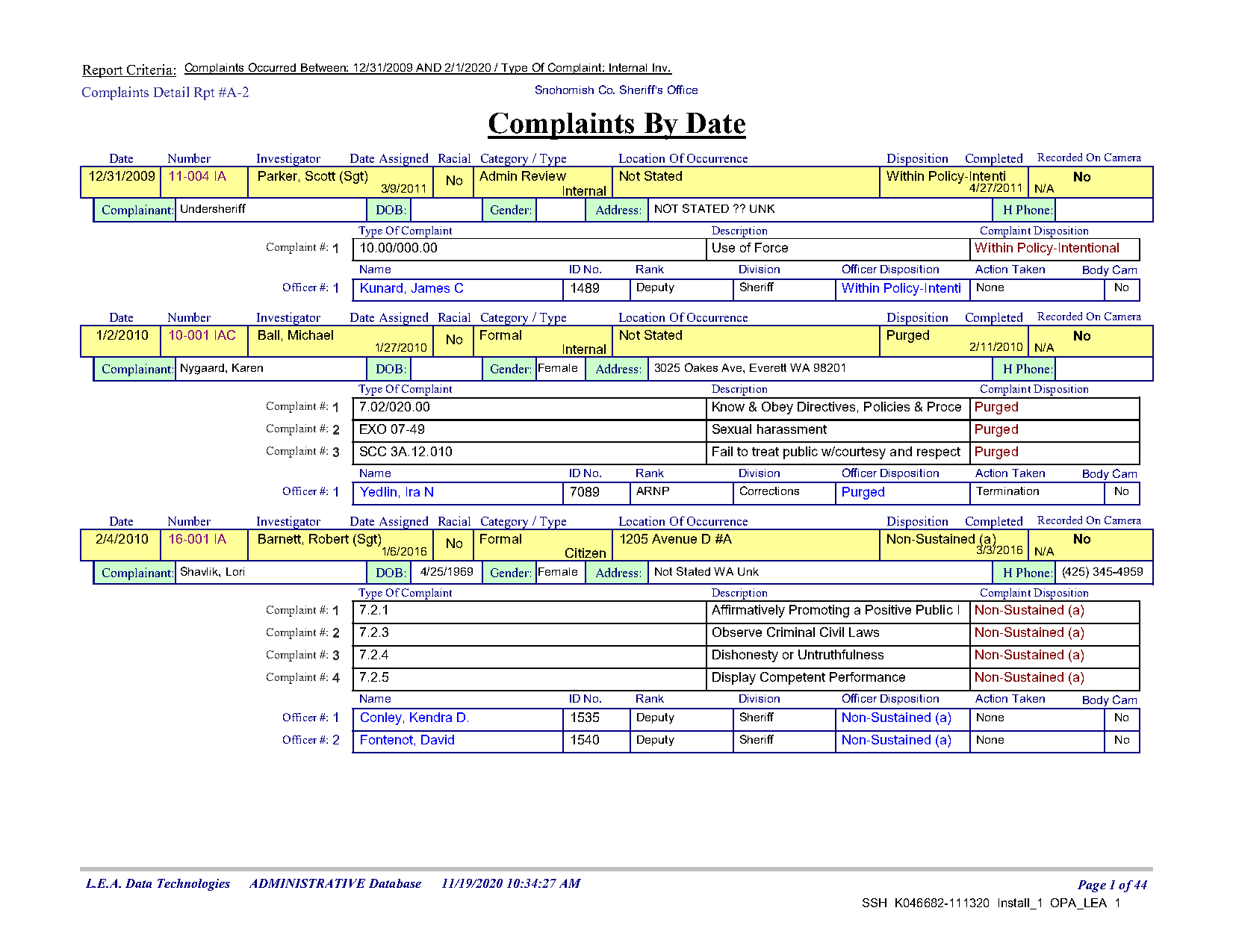
Exclude the report chrome
Section titled “Exclude the report chrome”Every page repeats the vendor footer and the report title. Register both as PDF-level exclusions so nothing downstream ever sees them:
pdf.add_exclusion(lambda page: page.find(text='L.E.A. Data Technologies').below(include_source=True))pdf.add_exclusion(lambda page: page.find(text='Complaints By Date').above(include_source=True))
page.show(exclusions='black')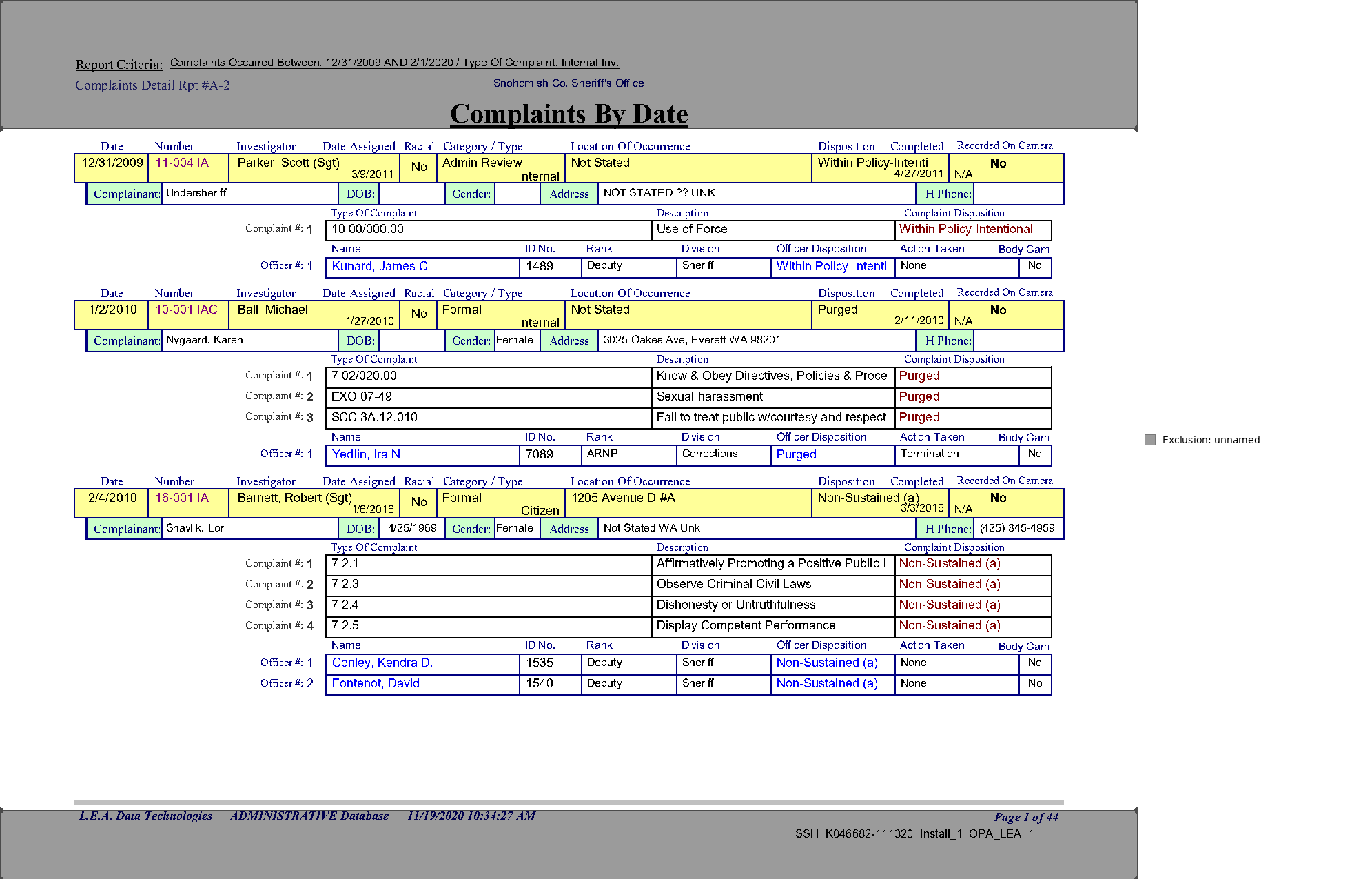
Break the document into one section per complaint
Section titled “Break the document into one section per complaint”The colored bars look like the obvious anchors, but text is usually the sturdier choice. Every record has a “Recorded On Camera” line, so cut the whole PDF into sections there. include_boundaries='start' keeps the anchor line inside its section:
sections = pdf.get_sections( 'text:contains(Recorded)', include_boundaries='start')sections.show(cols=3)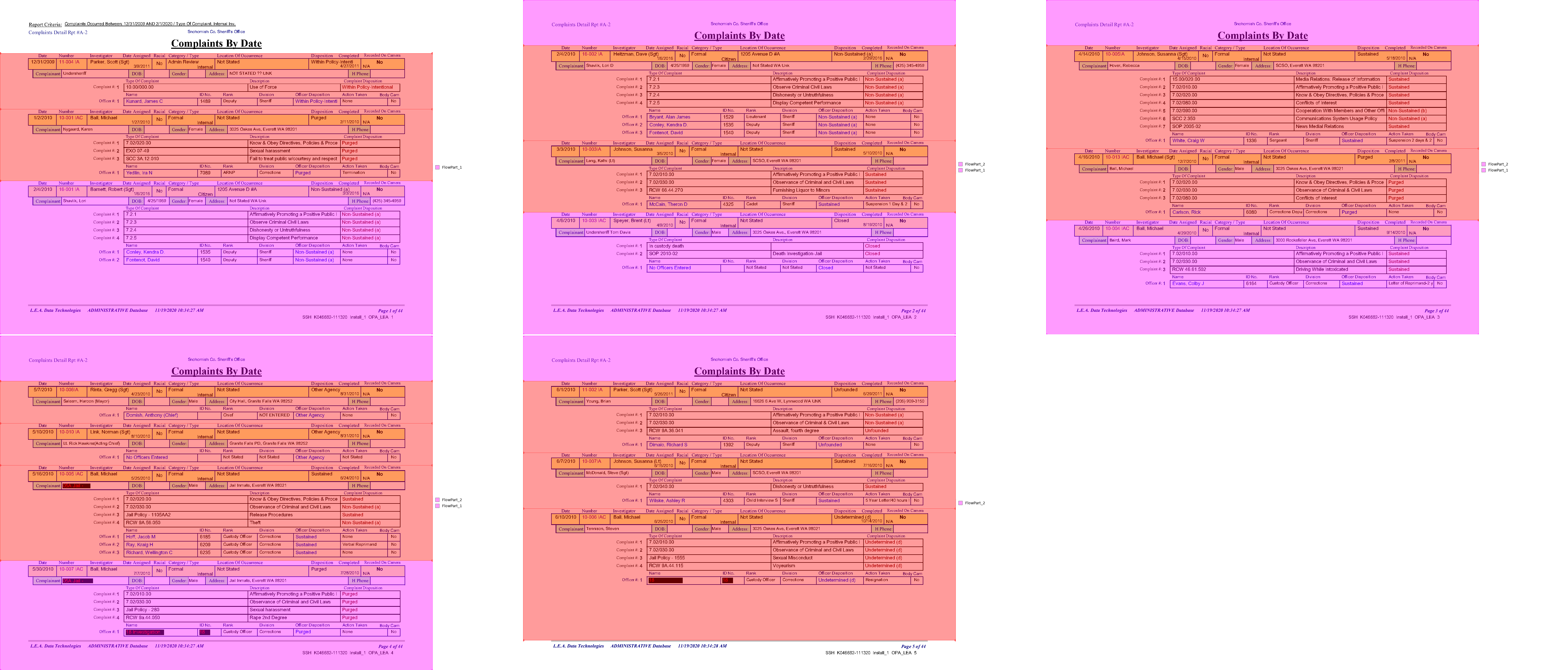
section = sections[3]section.show(crop=True)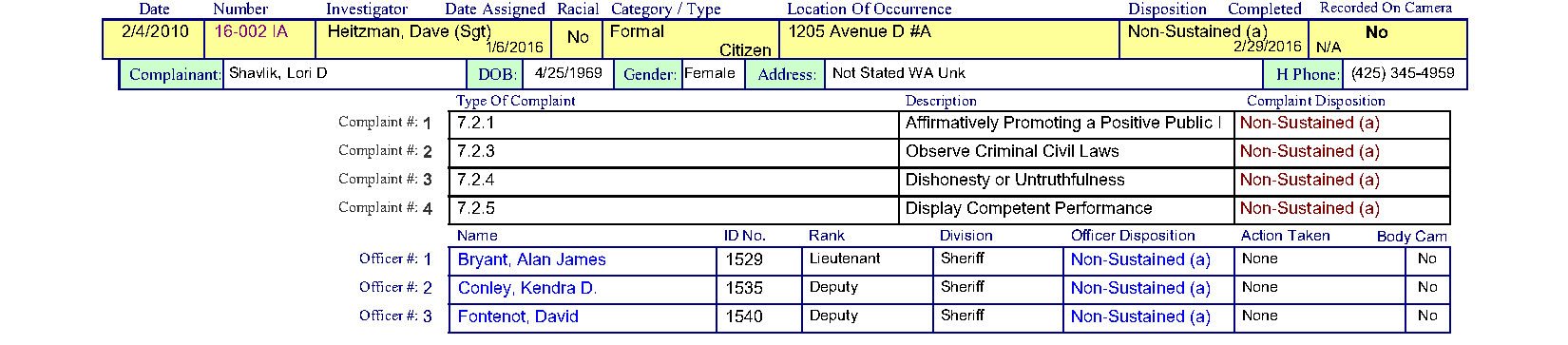
Every section has the same skeleton, even when fields are blank — which turns the rest of this into “solve one section, then loop.”
Label-value pairs
Section titled “Label-value pairs”For the fields up top, find the label and walk right until the next piece of text:
complainant = ( section .find("text:contains(Complainant)") .right(until='text'))print("Complainant is", complainant.extract_text())complainant.show(crop=100)Complainant is Shavlik, Lori D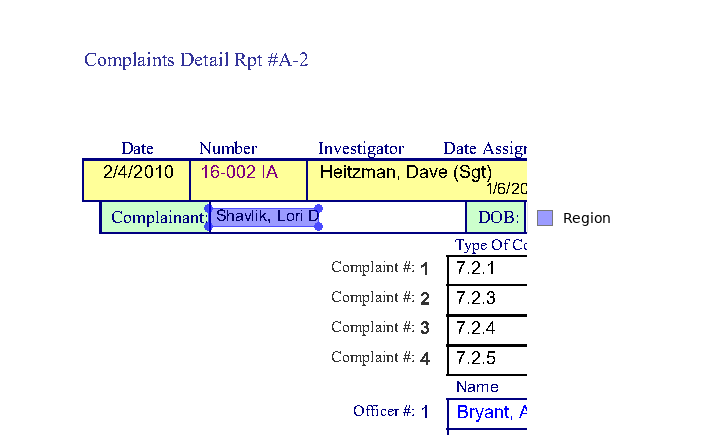
Date of birth is missing in many records — but this report helpfully prints empty text elements in the blank slots, so until='text' still stops in the right place instead of running into the next column:
dob = ( section .find("text:contains(DOB)") .right(until='text'))print("DOB is", dob.extract_text())dob.show(crop=100)DOB is 4/25/1969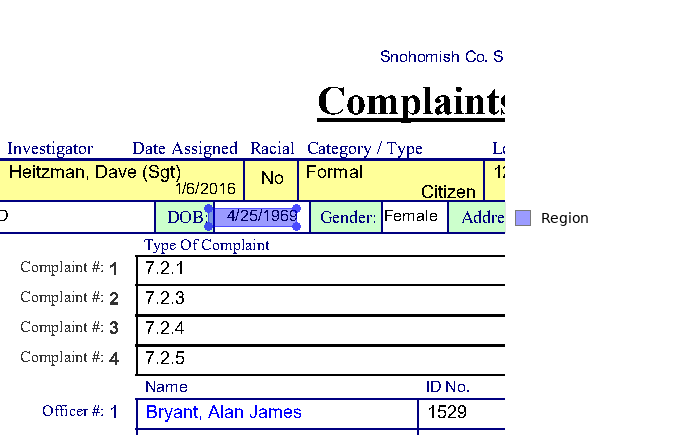
For labels whose value sits underneath, .below(until='text') stops at the first text it touches — but touching isn’t containing. The region only overlaps the start of the case number, and extracting it would clip the value:
number = ( section .find("text:contains(Number)") .below(until='text', width='element'))print("Number is", number.extract_text())number.show(crop=100)Number is 16-002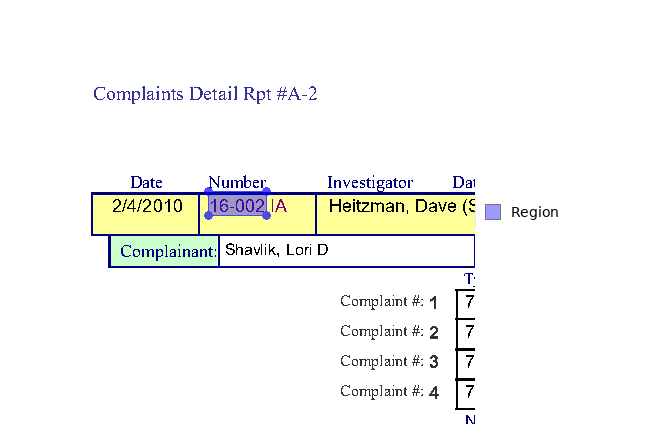
Ask for the element that partially overlaps the region instead — that expands the grab to the whole number:
number = ( section .find("text:contains(Number)") .below(until='text', width='element') .find('text', overlap='partial'))print("Number is", number.extract_text())number.show(crop=100)Number is 16-002 IA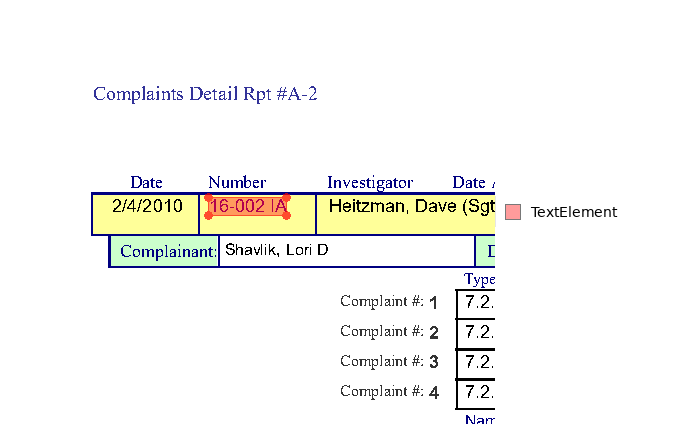
“Date Assigned” needs the opposite discipline: the value you want is fully underneath the label, and the neighboring sergeant’s name is close enough that until='text' would stop on it:
( section .find('text:contains(Date Assigned)') .below(width='element') .show(crop=100))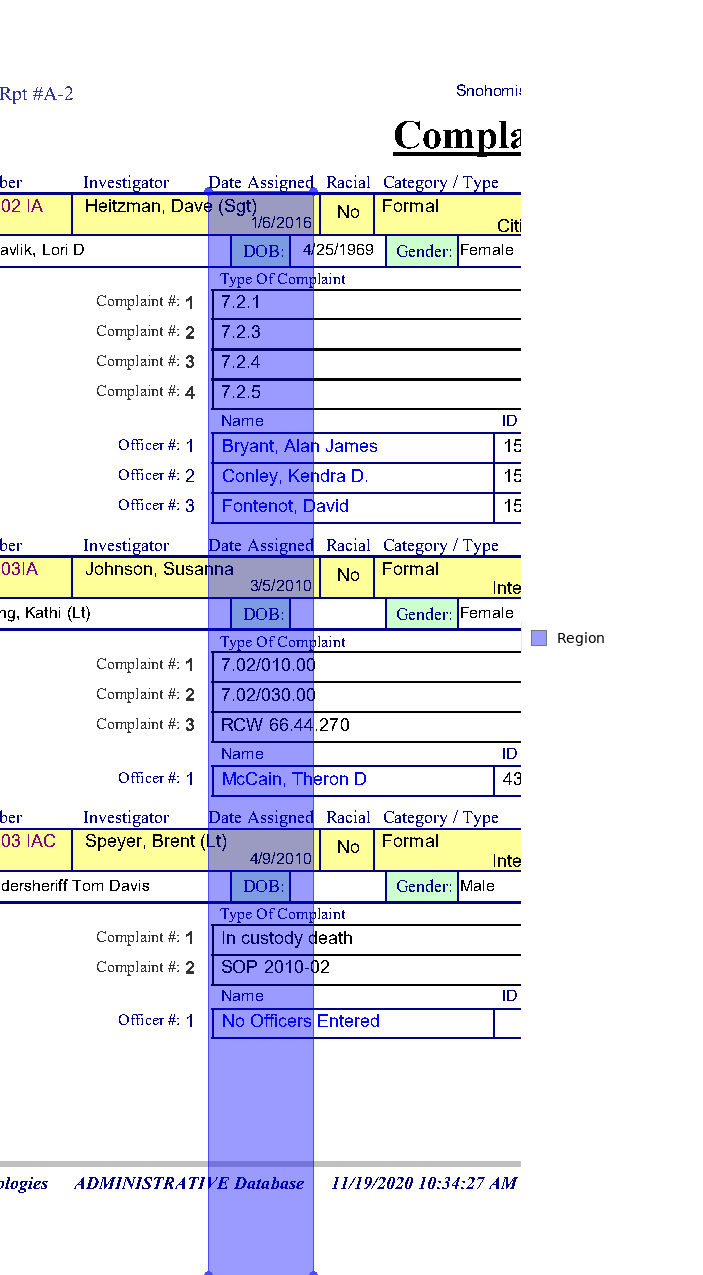
.find('text') inside the region defaults to full containment — only elements entirely inside count:
( section .find('text:contains(Date Assigned)') .below(width='element') .find('text') .extract_text())'1/6/2016'Same three moves — right-until, below-with-partial, below-with-containment — cover every field on the form.
The complaint table
Section titled “The complaint table”The tables look like the hard part, but it’s just: describe the area, extract. The complaint rows all start with “Complaint #”, so the table is everything to the right of those labels:
( section .find_all('text:contains(Complaint #)') .right(include_source=True) .show(crop=section))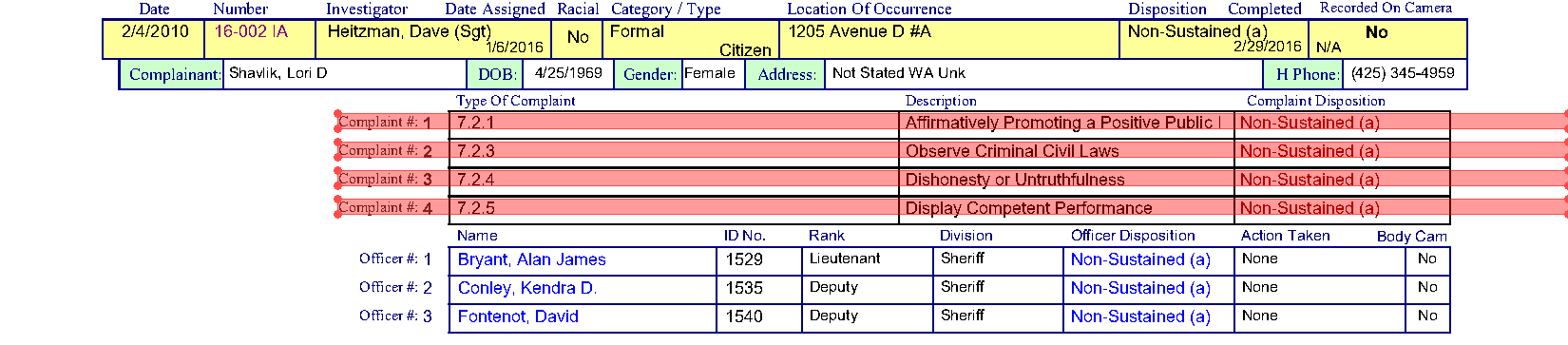
.merge() fuses the row-strips into one region, and a small expand catches the borders:
( section .find_all('text:contains(Complaint #)') .right(include_source=True) .merge() .expand(top=5, bottom=7) .show(crop=section))
Typing three header names is faster than scraping them:
( section .find_all('text:contains(Complaint #)') .right(include_source=True) .merge() .expand(top=5, bottom=7) .extract_table() .to_df(header=['Type of Complaint', 'Description', 'Complaint Disposition']))| Type of Complaint | Description | Complaint Disposition | |
|---|---|---|---|
| 0 | 7.2.1 | Affirmatively Promoting a Positive Public I | Non-Sustained (a) |
| 1 | 7.2.3 | Observe Criminal Civil Laws | Non-Sustained (a) |
| 2 | 7.2.4 | Dishonesty or Untruthfulness | Non-Sustained (a) |
| 3 | 7.2.5 | Display Competent Performance | Non-Sustained (a) |
That works — here. On sections with redactions, the black boxes fool the column detector. The vertical rules are still visible, though — they’re painted rather than stored as vector lines, so detect them from the rendered pixels and demand exactly four of them:
from natural_pdf.guides import Guides
table = (    section    .find_all('text:contains(Complaint #)')    .right(include_source=True)    .merge()    .expand(top=5, bottom=7))
guides = Guides(table)guides.vertical.from_lines(n=4, detection_method='pixels')
( table .extract_table(verticals=guides.vertical) .to_df(header=['Type of Complaint', 'Description', 'Complaint Disposition']))| Type of Complaint | Description | Complaint Disposition | |
|---|---|---|---|
| 0 | 7.2.1 | Affirmatively Promoting a Positive Public I | Non-Sustained (a) |
| 1 | 7.2.3 | Observe Criminal Civil Laws | Non-Sustained (a) |
| 2 | 7.2.4 | Dishonesty or Untruthfulness | Non-Sustained (a) |
| 3 | 7.2.5 | Display Competent Performance | Non-Sustained (a) |
The officers table
Section titled “The officers table”Same recipe, different anchor and column count:
table = (    section    .find_all('text:contains(Officer #)')    .right(include_source=True)    .merge()    .expand(top=5, bottom=7))
guides = Guides(table)guides.vertical.from_lines(n=8, detection_method='pixels')
( table .extract_table(verticals=guides.vertical) .to_df(header=['Name', 'ID No.', 'Rank', 'Division', 'Officer Disposition', 'Action Taken', 'Body Cam']))| Name | ID No. | Rank | Division | Officer Disposition | Action Taken | Body Cam | |
|---|---|---|---|---|---|---|---|
| 0 | Bryant, Alan James | 1529 | Lieutenant | Sheriff | Non-Sustained (a) | None | No |
| 1 | Conley, Kendra D. | 1535 | Deputy | Sheriff | Non-Sustained (a) | None | No |
| 2 | Fontenot, David | 1540 | Deputy | Sheriff | Non-Sustained (a) | None | No |
Loop it: one row per complaint
Section titled “Loop it: one row per complaint”Everything above, applied to every section. The Date Assigned/Completed regions get a few pixels of side expansion because the dates run slightly wider than their labels:
rows = []for section in sections:    complainant = section.find("text:contains(Complainant)").right(until='text')    dob = section.find("text:contains(DOB)").right(until='text')    address = section.find("text:contains(Address)").right(until='text')    gender = section.find("text:contains(Gender)").right(until='text')    phone = section.find("text:contains(H Phone)").right(until='text')    investigator = (        section        .find("text:contains(Investigator)")        .below(until='text', width='element')        .find('text', overlap='partial')    )    number = (        section        .find("text:contains(Number)")        .below(until='text', width='element')        .find('text', overlap='partial')    )    date_assigned = (      section      .find('text:contains(Date Assigned)')      .below(width='element')      .expand(left=5, right=5)      .find('text')    )    completed = (      section      .find('text:contains(Completed)')      .below(width='element')      .expand(left=5, right=5)      .find('text')    )    recorded = (      section      .find('text:contains(Recorded)')      .below(until='text', width='element')      .expand(left=5, right=5)    )
    row = {}    row['complainant'] = complainant.extract_text()    row['investigator'] = investigator.extract_text()    row['number'] = number.extract_text()    row['dob'] = dob.extract_text()    row['address'] = address.extract_text()    row['gender'] = gender.extract_text()    row['phone'] = phone.extract_text()    row['date_assigned'] = date_assigned.extract_text()    row['completed'] = completed.extract_text()    row['recorded'] = recorded.extract_text()    rows.append(row)
print("We found", len(rows), "rows")
We found 16 rowsimport pandas as pd
df = pd.DataFrame(rows)df| complainant | investigator | number | dob | address | gender | phone | date_assigned | completed | recorded | |
|---|---|---|---|---|---|---|---|---|---|---|
| 0 | Undersheriff | Parker, Scott (Sgt) | 11-004 IA | Gender: | NOT STATED ?? UNK | Address: | 3/9/2011 | 4/27/2011 | No | |
| 1 | Nygaard, Karen | Ball, Michael | 10-001 IAC | Gender: | 3025 Oakes Ave, Everett WA 98201 | Female | 1/27/2010 | 2/11/2010 | No | |
| 2 | Shavlik, Lori | Barnett, Robert (Sgt) | 16-001 IA | 4/25/1969 | Not Stated WA Unk | Female | (425) 345-4959 | 1/6/2016 | 3/3/2016 | No |
| 3 | Shavlik, Lori D | Heitzman, Dave (Sgt) | 16-002 IA | 4/25/1969 | Not Stated WA Unk | Female | (425) 345-4959 | 1/6/2016 | 2/29/2016 | No |
| 4 | Lang, Kathi (Lt) | Johnson, Susanna | 10-003IA | Gender: | SCSO, Everett WA 98201 | Female | 3/5/2010 | 5/10/2010 | No | |
| 5 | Undersheriff Tom Davis | Speyer, Brent (Lt) | 10-003 IAC | Gender: | 3025 Oakes Ave., Everett WA 98201 | Male | 4/9/2010 | 8/19/2010 | No | |
| 6 | Hover, Rebecca | Johnson, Susanna (Sgt) | 10-005IA | Gender: | SCSO, Everett WA 98201 | Female | 4/15/2010 | 5/18/2010 | No | |
| 7 | Ball, Michael | Ball, Michael (Sgt) | 10-013 IAC | Gender: | 3025 Oakes Ave, Everett WA 98021 | Male | 12/7/2010 | 2/8/2011 | No | |
| 8 | Baird, Mark | Ball, Michael | 10-004 IAC | Gender: | 3000 Rockefeller Ave, Everett WA 98201 | Male | 4/29/2010 | 9/14/2010 | No | |
| 9 | Saleem, Haroon (Mayor) | Rinta, Gregg (Sgt) | 10-006IA | Gender: | City Hall, Granite Falls WA 98252 | Male | 4/23/2010 | 8/31/2010 | No | |
| 10 | Lt. Rick Hawkins(Acting Chief) | Link, Norman (Sgt) | 10-010 IA | Gender: | Granite Falls PD, Granite Falls WA 98252 | Address: | 8/10/2010 | 8/31/2010 | No | |
| 11 | 05A Jail - | Ball, Michael | 10-005 IAC | Gender: | Jail Inmate, Everett WA 98021 | Male | 5/25/2010 | 6/24/2010 | No | |
| 12 | 05A Jail - | Ball, Michael | 10-007 IAC | Gender: | Jail Inmate, Everett WA 98201 | Male | 7/7/2010 | 7/28/2010 | No | |
| 13 | Young, Brian | Parker, Scott (Sgt) | 11-002 IA | Gender: | 16626 6 Ave W, Lynnwood WA UNK | Address: | (206) 909-3150 | 5/26/2011 | 6/29/2011 | No |
| 14 | McDonald, Steve (Sgt) | Johnson, Susanna (Lt) | 10-007IA | Gender: | SCSO, Everett WA 98201 | Male | 6/15/2010 | 7/16/2010 | No | |
| 15 | Tennison, Steven | Ball, Michael | 10-006 IAC | Gender: | 3025 Oakes Ave, Everett WA 98021 | Male | 6/25/2010 | 10/14/2010 | No |
And one combined CSV for the officer tables
Section titled “And one combined CSV for the officer tables”The one-to-many side works the same way, with the case number carried along so the tables stay joinable:
officer_dfs = []for section in sections:    # Not every section has officers — skip the ones without    if 'Officer #' not in section.extract_text():      continue
    case_number = (        section        .find("text:contains(Number)")        .below(until='text', width='element')        .find('text', overlap='partial')        .extract_text()    )
    table = (        section        .find_all('text:contains(Officer #)')        .right(include_source=True)        .merge()        .expand(top=3, bottom=6)    )
    guides = Guides(table)    guides.vertical.from_lines(n=8, detection_method='pixels')    columns = ['Name', 'ID No.', 'Rank', 'Division', 'Officer Disposition', 'Action Taken', 'Body Cam']    officer_df = (      table      .extract_table(verticals=guides.vertical)      .to_df(header=columns)    )
    officer_df['case_number'] = case_number    officer_dfs.append(officer_df)
print("Combining", len(officer_dfs), "officer dataframes")df = pd.concat(officer_dfs, ignore_index=True)df.head()
Combining 16 officer dataframes| Name | ID No. | Rank | Division | Officer Disposition | Action Taken | Body Cam | case_number | |
|---|---|---|---|---|---|---|---|---|
| 0 | Kunard, James C | 1489 | Deputy | Sheriff | Within Policy-Intenti | None | No | 11-004 IA |
| 1 | Yedlin, Ira N | 7089 | ARNP | Corrections | Purged | Termination | No | 10-001 IAC |
| 2 | Conley, Kendra D. | 1535 | Deputy | Sheriff | Non-Sustained (a) | None | No | 16-001 IA |
| 3 | Fontenot, David | 1540 | Deputy | Sheriff | Non-Sustained (a) | None | No | 16-001 IA |
| 4 | Bryant, Alan James | 1529 | Lieutenant | Sheriff | Non-Sustained (a) | None | No | 16-002 IA |
Repeat with the “Complaint #” anchor and n=4 for the complaints table, and the relational database this printout came from is a database again.